
How My Father Loved
Salt, Sun, and the Shape of My Name in Sand

Every year, the stretch between June 20 and July 5 holds a quiet, aching weight. June 20 was my dad’s birthday. He died just two weeks later, on July 5. The span between those dates always feels suspended in time—sunlit and sticky, marked by memory. Even when I’m not thinking about him directly, my body knows.
I find myself feeling the warmth of summer sun on my shoulders, sand between my toes, my dad’s laugh carried by the wind and the waves.
My father’s favorite place was the beach in the height of summer. At 14, he moved to Wildwood, New Jersey for the summer, meeting his older brother to work on the boardwalk at a hoagie shop called Al’s. His brother came home after a few weeks because he missed his girlfriend, but my dad stayed the entire three months. He fell in love with the whole scene.
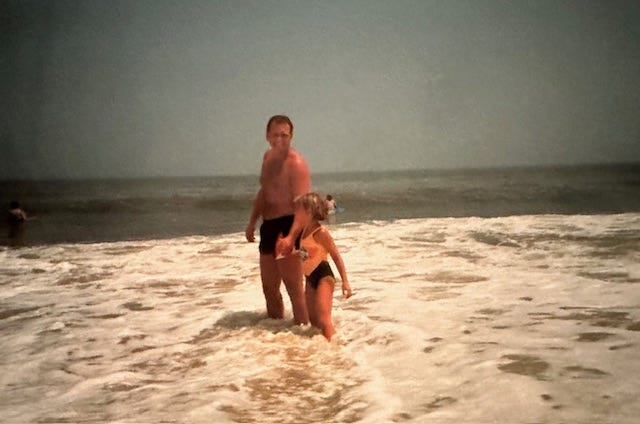
As a father, his greatest expression of love was to plug his children into the full spectrum of his own joy. No matter how much his job as a regional sales manager bogged him down—a relentless boss named Lyle, unexpected deadlines, last minute business trips—my father made room for play. He loved the water, the sun, the boardwalk. Whether it be Ocean City in Maryland or New Jersey, a summer was not complete without a week at the shore.
When I was little, I hated the sand at the beach. The grains that stuck to the soles of my feet, my knees, my hands, the clumps that would sit in the crotch of my swimsuit weighing it down. To escape the sand, I would climb onto my dad’s lap, onto his tan belly warm from the sun. I’d press my face close to his and smell the salt air and sunscreen.
He would hold me there, in my little white sun bonnet, relaxed into the fabric back rest of the multi-colored striped beach chair, elbows propped on the wooden arms, legs bent at the knees, toenails peeking out of the white sand. Dad always faced his chair toward the blazing sun and read John Grisham and Lee Child paperbacks. He didn’t drink beer like the other adults, and he never fell asleep.
He was so awake.
When I grew out of my opposition to sand, my dad, with his little yellow sand shovel, would dig out my name in massive letters in all caps. K E R I. Kneeling on all fours in his fluorescent swim trunks and mirrored Oakleys, with sweat beading his tanned forehead, he’d spend over an hour digging. In my swim team Speedo, I’d sit in the K while he dug the E and so on.
Watching my father, the one who chose my name at my birth, carve out my name in the sand, sent the gleeful beat of a hummingbird’s wings through my chest. It made me feel important, seen, loved. Sometimes if we stayed long enough for the tide to come in, the bottoms of the letters would fill with water and slowly dissolve. As the water receded, my name went with it.
The beauty of impermanence was always a reminder to linger in the moment until I could come back again.
Dad’s past experience working on the boardwalk meant that he was an expert at all the games. Teenagers called out over staticky microphones on coiled black wire, emanating voices that crackled, “Step right up! Who’s going to be the next lucky winner?”
Dad’s favorite game was Frog Bog, and he never failed to slam the mallet and send the rubber green frog, usually missing at least one leg from tireless summers at work, flying through the air to land on a rotating lily pad. He often drew a crowd, strangers cheering as each of his three frogs landed on lily pads, securing an even bigger stuffed animal prize each time. I don’t remember splashes of water, only precise splats. My father would raise his sandy brows over his eggshell blue eyes: “Which animal do you want, girls?”
And as my sister and I pointed to the wall of stuffed lions, resting prone, or blue whales with sad eyes, my dad would pass the game operator, a girl with white blond hair and wad of electric yellow gum, a crinkled five dollar bill in exchange for three more frogs. Then, he’d win a stuffed animal for a kid who was watching nearby, whose father had drained at least twenty dollars on Frog Bog in an attempt to satiate his round-faced little girl.
Dad might take us to Dime Toss to try a few rounds, but when we would ask to play Milk Bottle, he’d tell us it was rigged, that there was no way to win, just like the softball in a basket game. The baskets were tilted just so that the ball rolled out every time. The cacophony of nearby arcade games and pinball machines, their trills and whistles, accompanied our walk down the diagonally running planks of gray wood.
The upstairs room of Dad’s favorite pizza restaurant, Mac and Manco’s, had no AC and was swarming with flies, but to watch my dad bite into a slice of pepperoni pizza dripping with grease was almost inspiring. He’d fold the slice of pizza, vertically, and hold it in his hand as he chewed, shaking it just a little up and down, up and down, up and down, his eyes unfocused, almost dreamy. When just the crust remained, he’d open it up, shake salt into the little boat and eat it salt side down.
After dinner, we’d walk again, passing by people licking Kohr Brother’s soft serve on airy cake cones. It would be vanilla for my mother, chocolate and mint twist for me and my sister, and orange creamsicle for my father. We’d go to our car chewing in a little circle around the cone all the way to its wafer bottom.
My father’s abundant sense of wonder and awe brought me directly to the present with a swift precision, like being in the moment was so necessary, so meant to be, and crucial not to miss. Dad leapt into action on our summer trips, and the effect was riding so close to the edge of excitement that I often experienced the sensation of falling off.
To swing on the pendulum with him—at home quiet and withdrawn and while traveling lively and animated—was often disorienting, and yet at the same time, I loved how those vacation moments sparkled. I felt eager to be a part of them with my father, and lucky to be one of the chosen few, to feel him next to me, so very much alive.
When I was in high school, my dad traded our boat for a wave runner, a lower maintenance adrenaline hit. At the shore one summer, he urged me to abandon my caution and ride with him into the ocean. We’d always stuck to the smooth predictability of the bay.
“Come on, Ker,” he said with a wide smile. He reached out his arm and gestured with his hand, an invitation I couldn’t refuse no matter how scared I felt. Despite being a competitive swimmer and having a deep love for the water, the ocean felt like an untamable force. It overwhelmed me in its wild unknown. What lurked at the depths, in the darkness, the places I couldn’t see, was what made me quiver. In the breakers by the shore, I felt the just-right amount of danger, but out where the water turned a darker shade of blue, I felt overcome.
The bottom of the wave runner smacked the water with great force as we crested and fell over waves. The wind whipped through my hair, and my bottom lifted off the padded seat then crashed down again. Salt water sprayed our feet and shins, occasionally our faces. My dad whooped, and I held tight to the straps of his life vest as we peaked and dipped through the mist. I was terrified of spilling into the deep abyss. When my teeth were so cold and dry that my lips couldn’t press together, I realized I was smiling, and I started to laugh.
“Look!” I remember Dad hollering as he took one hand off the steering to point into the water beside us. Dolphins swam with us, so close I could have reached out and touched their glistening, milky gray fins.
*
There’s always a line. But it’s one stand in particular, and not the one with someone’s surname boasting claim to the food it sells, but the stand that is lit up in blue and white fluorescent and sports a more common name in loopy cursive: Boardwalk Fries.
While my mother and sister shop in a store called Ocean Waves for airbrushed shirts, I stand in the line with my father. He’s wearing khaki cargo shorts that drop to his knee, a golf polo with a little marlin logo in mid-dive on the right side of his chest. With white ankle socks and black Adidas sneakers, my father waits with his hands stationed on his hips.
I wonder how his mother felt about her son leaving home at fourteen to work on the boardwalk. Maybe she was relieved to see him go, to see him escape his father’s belt. Maybe she was sad to see her favored son drop away. Maybe she counted on the money he would bring home at the end of that summer, in a wrinkled white envelope I imagine, labeled, Mom.
When we approach the white formica countertop at the order window, Dad orders two large fries, and two Diet Cokes. The countertop is slick with grease and scattered with lost fries. Two cornflower blue pails of an obscene amount of fresh cut french fries pop out of the pick-up window.
We slide down the counter to retrieve our prize, receiving the pass through the little hole and inevitably losing a few fries to the collection below. I pick up an opaque squeeze bottle of Heinz malt vinegar and douse my fries heavily with the pungent liquid. Saliva builds in the sides of my mouth, down by the base of my tongue, and I swallow.
My father takes the vinegar and does the same as I reach for the handle on a wide plastic salt shaker. The humidity of the ocean air has formed the salt into one clump, and I bang the heel of my hand against the bottom of the shaker to try to loosen it up.
My dad takes it from me and opens the lid. He uses his fingers to pinch some salt from the mass and sprinkles shimmering white across the top of my overflowing bucket of hot russets. The first layer is crispy, melt in my mouth, Crisco coating my tongue, the salt, the vinegar, the warmth—I eat with epic focus.
The benches are full, so we walk down onto the sand and sit on the edge of the boardwalk, my feet in strappy Tevas dangling. I can see the little escape holes that translucent ghost crabs make when they pop out at night to run sideways across the sand before tucking back underground. The ocean is far away enough that I can barely hear the waves crashing against the shore; it sounds like a whisper, like the white noise of a womb, coaxing a baby to safety, watery and warm.
My dad and I don’t talk to one another. We eat, focusing on the bucket I’m holding, saving the other for my mother and sister. When the fries get soggy, toward the middle, my dad stops and wipes his hands on a brown napkin that’s already grease splattered somehow.
I keep eating, licking my fingers between fries, watching the seagulls circle round and round over head. The bustle of the boardwalk behind us is in full swing as the sky grows darker. At the end of the walk, by the pier, there are amusement park rides, but we will save that for another night. Tonight is about tasting the flavors that we’ve waited a year for, about running on the fumes of a fourteen-year-old boy’s first summer away from home.
*
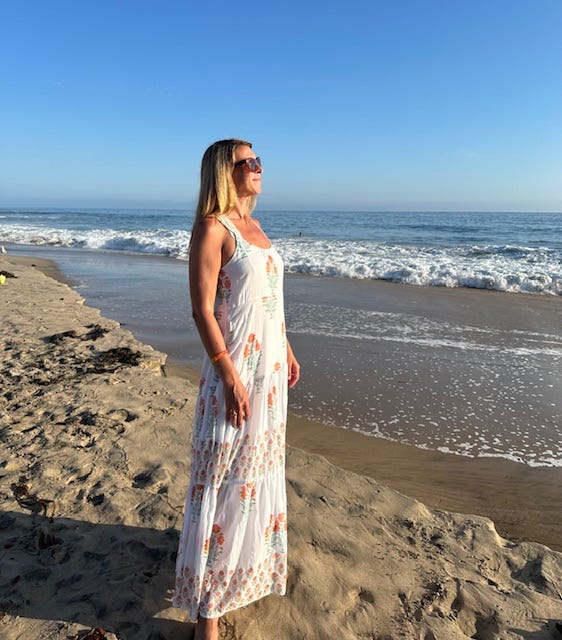
Now, in my own life, this time of year always brings my father close. It’s not dramatic—just small things. I find myself craving vinegar on fries or turning my heart toward the sun without thinking. I notice the way I scan my kids’ faces when they’re caught in a moment of joy, the way he used to look at us.
Some memories have softened at the edges, but others land with sharp clarity—like the sound of his voice when he said my name or those last few weeks of his life, when I was lucky enough to care for him as he faded. I don’t try to hold onto them too tightly anymore. I let them come and go, like the tide.
What stays is the shape of his presence in the way I move through summer: alert, alive, and still looking for the magic.
Beautiful, Ker. This depicts him perfectly. I started sobbing at the frog bog and can’t stop. Thank you for helping bring these memories alive. Dad would be beyond proud. 💛
I feel like I just got to meet your dad, Keri--what a gift! Thank you, friend