
Six Problems Ago

This past weekend my 15-year-old son performed in Hadestown through his Actors Academy. I’d taken him and his brother to New York City in the fall to see it on Broadway, and the three of us were so moved. And perhaps I’m biased given my firstborn was in this weekend’s production, but I loved it even more this time around.
It’s such a timely production, which hopefully will be clear after a brief synopsis for those who haven’t seen or heard of the show. (Warning: spoiler alert.) The musical is set in a more modern world, though its characters and storyline are rooted in Greek mythology. Hades, ruler of the Underworld—called Hadestown—and his wife Persephone rule over a polarized divide between those above ground and those below, where workers labor endlessly building walls that promise security but deepen their confinement and disconnection. (Sound familiar?)
Threaded through their story is the love story of Orpheus and Eurydice. Orpheus is a songwriter convinced that music and beauty can soften the hardest hearts, even the one belonging to Hades. Eurydice is more wary of a world, believing it to be cold and unforgiving. When desperation leads Eurydice to the Underworld, Orpheus follows, determined to bring her back.

Hades eventually agrees to let her return with him, but on one condition: Eurydice will walk behind Orpheus on the long journey back to the surface, and he must not look back to see if she is still there. If he does, she will be lost to him forever.
The tension of the story lives inside that walk, and watching it unfold on the both the Broadway stage and my teenage son’s Actors Academy stage gave me instant goosebumps. One character in front of the other. The music, the song, the movement, the deliberate space between.
It is in the walk that the audience is invited into the very real human emotions of trust, doubt, hope, and fear. The mind’s relentless urge to check, to confirm, to control what cannot actually be controlled.
And if you know the myth, you know what happens. Orpheus looks back.
In a recent meeting I was part of, someone asked a question that caught my attention:
What was your problem six problems ago?*
I tried to remember.
I couldn’t. Or at least not with any clarity.
But this was the speaker’s point. Very few of us likely remember what our problem was six problems ago, and I am no exception. I am sure there was a thing that once consumed me, that felt like the axis upon which everything turned, a thing that has either resolved, or evolved, or become part of the story rather than the whole story.
I understand the type of problems I’m referring to may not be the massive life-altering ones. The ones we tend to remember in what sometimes feels like an unfortunate amount of detail. But even those, like the end of a relationship or a difficult rupture or the loss of a loved one, have a tendency to soften with time.
I remember writing, after the end of my ten-year relationship, that I didn’t trust my own hands to soothe myself. And, in the beginning, when the grief was in its most raw form, my hands didn’t offer much comfort.
Yet, still I tried, laying in bed, resting one hand over my low belly, the other over my heart. Breathing into the warmth, sometimes never quelling that vibration that hummed just below the surface of my skin. I remember being in Taiwan that first summer, sitting under rainfall in Beitou at the hot springs, desperately praying for the water to wash it all away, to fill me with the ability to meet myself.
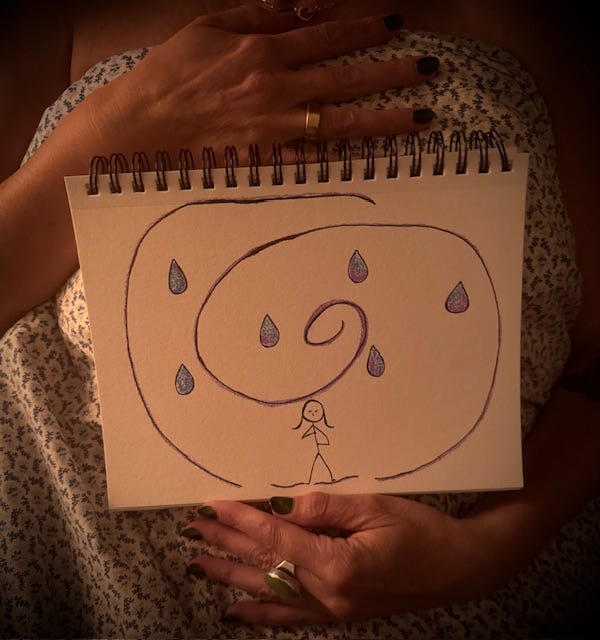
My therapist explained that there are very young, attachment-based reflexes that live inside the body—movements we learn long before we have language. One of them is the reach: the instinct to extend ourselves toward another when something inside feels unsteady. The reaching itself isn’t the problem. In healthy attachment, someone meets us there. They gather us in, and our nervous system settles. This is what I’ve tried to offer my own children, as best as I can, from the very beginning.
But sometimes in a lifetime, that reach goes unanswered, or answered inconsistently, and the body learns something else. It learns to either keep reaching to no avail or to stop reaching altogether, also to no avail. In my former relationship, I didn’t know anything different, partly because of our dynamic and partly because I hadn’t yet learned how to come back to myself.
The counter-movement, my therapist told me, is the yield. The ability to let the body settle back into itself, to feel the support beneath us, to trust that something inside us can hold what is rising.
No sudden cleansing at those hot springs arrived. Instead, something quieter began to take shape in the weeks, months, years that followed. Showing up with consistency over time, I began to notice a difference. At first it was slight. Maybe my body could rest just a little heavier into my mattress or yoga mat. Or perhaps during a hike, when I did the same—one hand to belly, one to heart—I’d experience the felt sense of expansion, like my chest was splitting open and light could come pouring out.
I learned something absolutely invaluable: not only how to reach toward myself but also that I had the capacity to yield—to self-soothe.
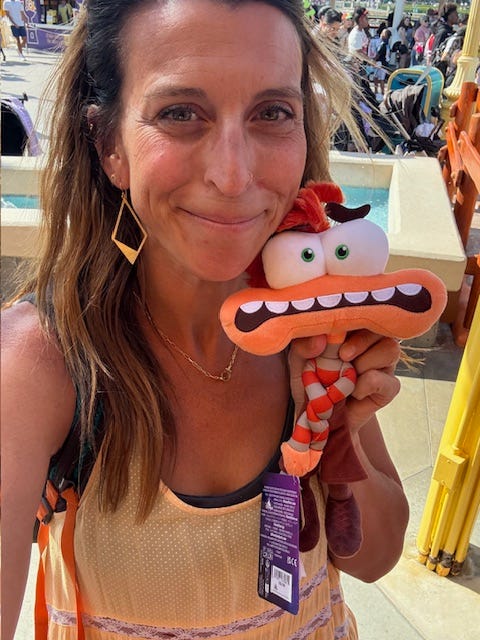
The “six problems ago” question came forward in the context of a conversation about what happens when we stop trying to exert our will onto how we think things should go in our lives and turn our life over to a higher power. It made me think about Orpheus, and how his turning around was such a natural human tendency. The pull to check, to make sure, to confirm that what we love is still there.
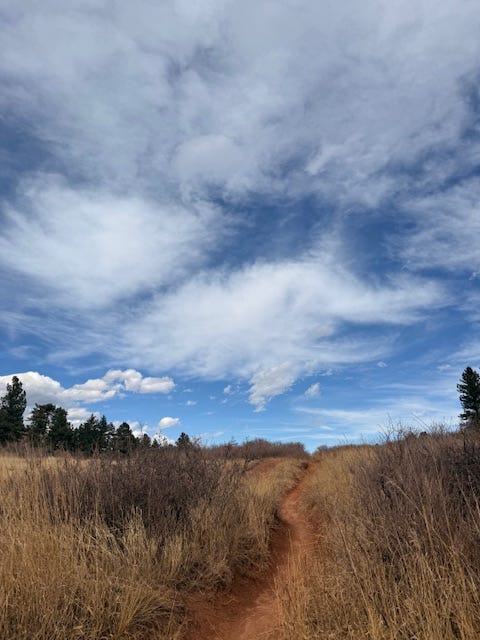
I know, it sounds a little woo, but surrendering to something greater than myself is what I’ve been attempting now for the past two years. “Higher power” is a tricky concept for me because it carries a “God” connotation, and I do not consider myself a religious person. I am, however, spiritual, and my higher power is the universe, nature, writing, a Gregory Alan Isakov song, the first bite of freshly baked sourdough, an intimate moment, acorns, the moon, oysters, being of service. It doesn’t take one form, and it isn’t in any church aside from the one under the pines.
When I keep walking, breathing, bringing my hands to my skin, I am completely anchored in the present moment; I’m not looking back ruminating on what was or looking forward fixated on what will be. Let me be clear; I do not have this completely dialed in by any means, but I am committed to the practice.
And for now, that’s enough.
*The person who asked the six problems ago question said it came from their favorite author, but when I Googled, I couldn’t find the source. Would love to know who originally said it, so if anyone knows, please leave the author’s name in the comments.
The beauty of getting older is I can't remember one problem ago, let alone six. And well said on higher powers -- they are what we make them to be and need them to be.